Saturday, July 6, 2013

We are Family!

My parents arrived in Cape Town on the 22nd of June.  I met them at a hotel in the city where we were going to stay for a few nights before starting our family road trip.  I'm not going to blog about everything that we did because it would be another blog in itself.  But, I'll give a brief summery.

Essentially, my family arrived, rented a car and then we spent around 3 weeks driving around South Africa.  We started in the south-western corner (Cape Town and Stellenbosch) and headed north-east towards Johannesburg and Soweto.  Along the way, we stopped at a bunch of places along the way including a humongous hole in the ground that used to be a diamond mine, and the Apartheid Museum in Jo'burg.  We made it to the eastern edge and drove around Etosha National Park.  Then we started heading south and hugged the coastline.  We stopped in the province of Kwazulu-Natal in a town called Eshowe where we first went to a cultural museum and then tried tripe and boiled dumplings in a basement of a local "restaurant."  We went hiking in the Drakensberg Mountains that border Lesotho, then drove through the Eastern Cape to Cape Agulhas (the southern most tip of Africa).  We finally made it back to Stellenbosch to celebrate my brother and mine 21st birthday.  We spent one more night in Cape Town and then we all got on airplanes.  My family was heading back to the US and I was heading to Malawi for a little more than two weeks of work at a non-profit.

It was so fun to travel with my family.  Not only was it great to finally see them in person, despite all of our video chatting, but it was fun to show them around where I had been living for around 6 months.  I was able to show them the classroom I worked in, the tire playground we built with the learners in their school yard and to cross the bridge that I bungee jumped off.  It was also nice to experience entirely new parts of the country and to learn more about its history and culture.  It was fun to see some of the places that I had learned and read about in my history class or heard other people talk about.

We took several hundred photos, so I'll only post some of the highlights here.


This is how I spent the first evening with my family - eating by myself and watching a movie and my family sleep.  I forgot that they wouldn't be used to the time change.


Planning our trip...


We spent the first day at Boudler Beach (penguins) and Cape Point.


It was fun to show my family where I had spent so much of my time and energy during the semester.  One of the projects that I helped with was building a play structure with the learners at Lynedoch.  My brothers and I are standing on our tire "snake" that we built with the grade 3 and 4 students.


In the distance is the Afrikaans Language Monument, which was built in the 70s to signify the importance of the Afrikaans language as well as the Afrikaner people.  


Just chillin' with the family - watching the Lion King.


Vineyards in the fall.


A typical dinner - cooking with a water boiler in whatever hotel/hostel/bed and breakfast type place we found for the night.


When my family asked if there was anything that I wanted to do before I left, one of the only things I really wanted to see was the Apartheid Museum near Jo'burg.

One of the interesting things the museum did was to categorize you by race according to your ticket.  Then we had to go in different doors and saw different things when first entering the museum.  It was a powerful way of giving visitors a tiny taste of what daily life was like under the apartheid regime.


Some of the sculpture outside of the museum.


At the end of the museum, there was an art instillation where guests got to pick a colored stick according to different values.  You then took a stick and placed it in boxes.  Funnily enough, each one of us took a different of the 5 colors.


Soweto was incredible.  It used to be a huge slum, and it still is a very poor area, but it has developed a little bit.  Soweto is short for "South West Township" and was were several influential anti-apartheid fighters were born like Oliver Tambo who helped start the ANC Youth League.  A huge student uprising against the introduction of Afrikaans as the main language in schools also took place here in the 70s.  What was most incredible about the area, however, was the shear number of houses and people living in the area.  It is kind of hard to tell, but on the hill behind all the cars are houses.  It was like this on all sides - a sea of houses for as far as the eye could see.


Monday, June 17, 2013

"All by Myself"

After we got back to Stellenbosch, I had about two weeks to just hang out before my parents and my brothers came to visit and when I needed to be out of my apartment.  I didn’t do anything that interesting within the two weeks except be with people before they went home, manage the extension of my visa in Cape Town, visit Lynedoch one more time, and start packing up all my stuff.  It wasn’t very exciting and I spent a lot of time by myself because by the end of the first week, nearly everyone was gone.


The last picture of our car - back home in Stellenbosch.


Stellenbosch in the fall.  It was lovely when the leaves were colors, but not quite as lovely as Maine.


One of the things I had to do before I left was to return my bike.  By the end, its bell was broken (it fell apart on the first day), the seat had a small rip, and the pedals didn't work so I literally had to drag my bike (wheels not spinning) back to the place where I got it.

Some pictures of my room in the midst of packing.


One of the other things I had to do, was use up all the food in my room.  Neil had also given me a bunch of stuff before he left, so I had tons of flour to make delicious bread.

Sunday, June 9, 2013

Day 19: It's raining men!

We had a relatively relaxed morning.  We had breakfast with the others and watched as they tried to fit everything back into their car.  After saying goodbye to everyone, Neil and I headed south while they headed north.  The final thing on our to do list was the Cederberg Mountains.  Although I had already been there, Neil really wanted to go hiking and I was more than happy to visit the area again - it was so beautiful.  The maps we had were a little confusing and we ended up stopping in a town called Clanwilliam to ask for directions.  These were less than helpful, but we did get to see the main Rooibos tea company's production plant, which was kind of exciting.

We finally made it the entrance to the park, and found ourselves on more dirt roads that were even bumpier than the ones in Namibia.  It was super muddy, and had started to rain and eventually downpour.  It was incredible how much it was raining - although I didn't see any gentlemen falling from the sky.  It put kind of a damper on the day.  While driving around, looking for a trail head, we saw another car that looked like it was having engine trouble.  We talked with the group, some other international students, and they said they were alright but that the road in front of us was flooded.  We decided to keep going a little ways and check it out to see if it was something that we could cross.  As it turns out, it was way to deep for out little car.  I got out to check the depth and it was up to my knees.

Because of the continual rain, the fact that we couldn’t get to the trail we wanted to hike and even if we could it would be awful hiking and camping conditions, we decided that we should just head home to Stellenbosch.  We found a bathroom, got a few more beautiful views of the mountains and headed home.

We arrived back in Stellenbosch around 8:30pm, made a quick stop at the grocery store and then arrived back to campus to make dinner.  Although it was sad that our trip was over, both Neil and I were glad to be back in a warm environment and sleep in our own beds.


All in all, it was a great trip.  We did and saw so much of a country, learned a little bit about its history, experienced some of its colonial and native culture, and had a ton of fun while doing it.  We drove 7605km (equivalent to 4725.5 miles) and ate somewhere between 6-8 bags of Sparkles (hard candies) and a few pounds of rice/cous cous/quinoa.  We saw over 20 different animal species and met some new, interesting and inspirational people.  I become more acquainted with country music and Neil (may have) come to understand my love for Pride and Prejudice.  We saw more straight roads and empty horizons than I ever thought was possible and went whole days without seeing more than a two or three other cars.  It was an amazing two weeks and a trip that I will never forget.  Thanks to our ventures, it became even more clear not only how big of a world we are in, but how small one person can be in comparison.


This is how deep the water was that was flooding the road.


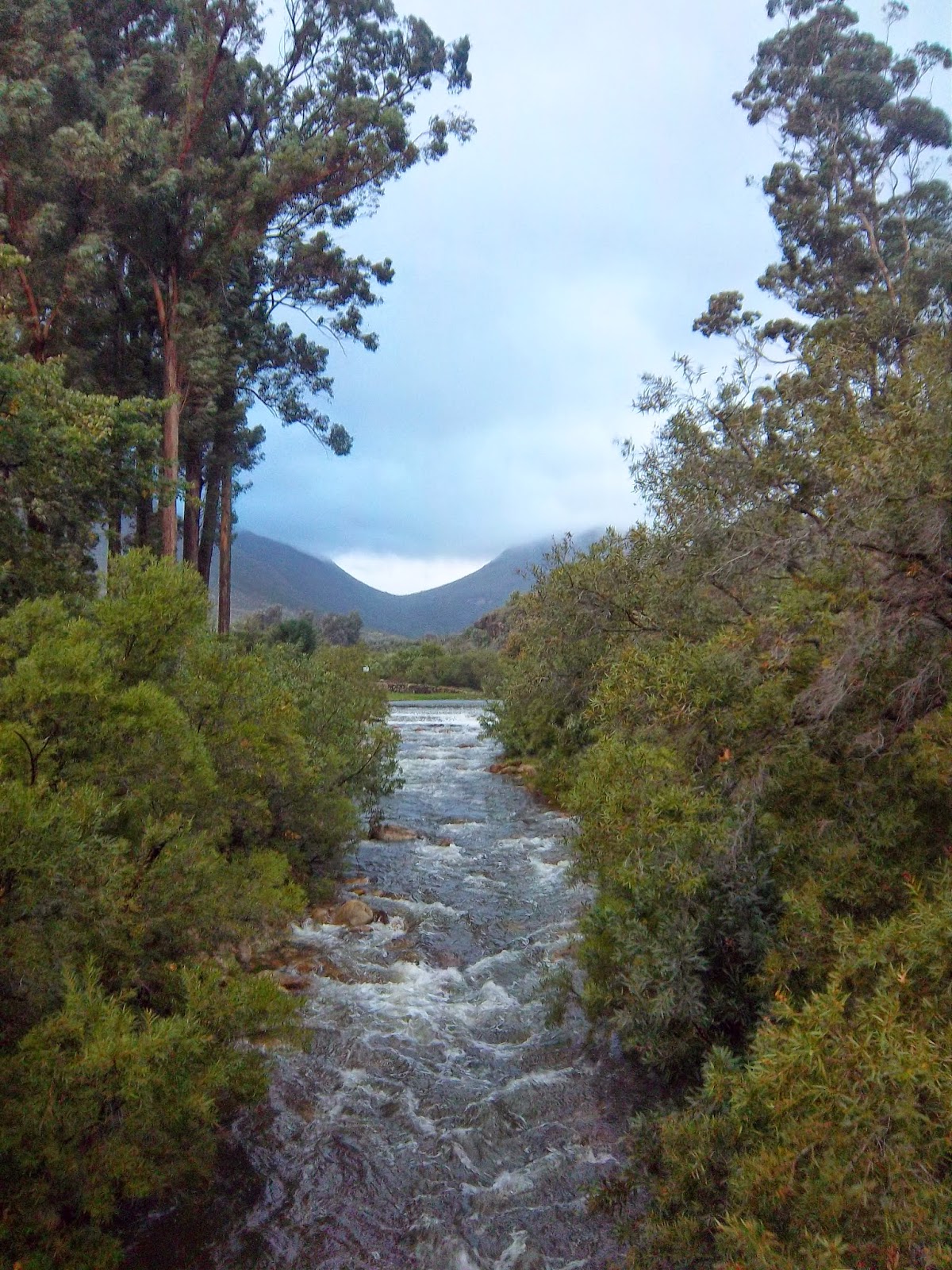
We stopped at one of the campsites to use their bathrooms before they left.  There was a small bridge crossing the river and this was the view from the middle.

While we were driving back towards the exit, we got some excellent views of the valley.


This was leaving the park.


As we were leaving, we were crossing the bridge (above) and when I looked out the window, it looked like we were floating in water.


On the road back home...


**Neil took most of these!!

Friday, June 7, 2013

Day 18: A "cross" country experience.

We spent the morning venturing around Luderitz.  We had to stop at the grocery store to resupply, but we also found some of the beautiful old German buildings.  We checked out an old church as well as the home of one of Namibia’s richest diamond giants.  One of the sites we went to was Felsenkirche or the Rock Church, which sits on Diamond Hill.  It was built in 1912 and is one of the oldest Lutheran churches in Namibia.  The location of the church was incredible.  It was right on the water and up on a hill overlooking the rest of the town.  It was locked so we couldn't see the inside, but I'm sure it was lovely.  Another building was called Goerke Haus.  It was built between 1909-1911 for Hans Goerke who was a manager and co-owner for the major diamond company at the time.  The architecture was so interesting and different than anything I had seen in South Africa, or even in other parts of Namibia.  Because of the colonial influences in Africa, it was neat to see all the different styles, from German in Namibia and Dutch/English in South Africa.

In 1487, when Bartolomeu Dias was returning from his voyage around the cape of Africa, his ships stopped along the coast of Namibia, in the bay that Luderitz is now situated.  While there, he erected a stone cross, also called a padrao, on the mainland.  In the 1980s, a replica cross was carved from dolerite and set in the original location.

The drive to the cross was incredible.  The landscape was so interesting and different than anything else we had seen.  During the drive we could see desert dunes, mountains and giant black rocks.  Throughout all of Namibia, not just today, I was struck by the harshness of our surroundings and I often wondered how people, especially those living in isolation, could sustain themselves.  We walked to the end of the point where the cross stood, enjoyed the sea breeze and even saw some seals and porpoises.  After that, we got back in the car and headed east.  We passed the wild horses again and stopped and watched them for a while before we turned off the main road to head south towards South African border.  

Along the main road that brings you to Luderitz is Kolmanskop, a ghost town in the Namib desert.  During the diamond rush in the early 1900s, it used to be rich mining village, as diamond supply decreased, the town was eventually abandoned in the middle of the 20th century.  You actually need a permit to go into the town because it is in diamond mining territory, so we only saw the buildings from the road.


With only a few more days of our trip, we needed to start heading south with a little more purpose.  We made our way back towards the Fish River Canyon National Park, which put us near the border with South Africa.  We drove into the park, stopped the car to watch the sun set and listen to a really lovely but depressing song on Neil’s iPod, and then drove out to find a place to park for the night.  We couldn’t find anything, so we ended up going back in and found an OK place a little ways off the road.  The weather was lovely, so we hung out and watched the moon and stars come out.

Our typical campsite...though the view was not always this good.


Goerke Haus


Felsenkirche (Rock Church)


On the way to the Dias Cross...Neil and his baby.


Leading up to the cross.  It's kind of hard to see, but at the end of the rock point, you can see the outline of the cross.


The lighthouse near the cross...


The ocean view.


The road heading east.


Kolmanskop in the distance.


The wild horses and their new friends.


** Around 85% of these pictures are Neils.

Day 19: Full Circle

We woke up early in the morning with the rising sun streaming in our tent and the sound of a car slowing down on the road right near where we were staying.  They kept driving, but we immediately got up, packed up in about 3 minutes and got on the road.  We drove a little ways and then stopped to watch the rest of the sun rise, use the facilities and make breakfast.  The last thing that we had decided to do before we crossed the border was go into the Ai-Ais Resort where we would be able to access the bottom of the First River Canyon.  There were also some hot springs that we thought we would check out.

When we arrived, we found the hot springs, which were not as exciting as we had thought they were going to be.  What we really wanted to do, however, was to walk in the bottom of the canyon that we had started our trip our with.  It was cool to be walking in something that was connected to what we had seen before - it was like we ended full circle, back where we had started, but in a new perspective.  After soaking up as much sun as possible, we got back in the car and started the long drive to the town were we were planning to stay for the night.  We crossed the border without any trouble, got another stamp in our passports and were struck with the almost immediate difference in environment.  As soon as we crossed into SA, there was much more vegetation and greenery.


Before we even left, we planned to meet some of our friends from Stellenbosch who were just starting their road trip at a campground near Springbok, SA.  We got there earlier than they did, so Neil and I set up camp, played frisbee with the owner’s little boy and enjoyed hot showers - something that hadn’t been done in a few days.  They were a group of 5 and their car was extremely full.  It was nice to see them, but it was even nicer (Neil and I both agreed) to have someone new to talk too.  It was exciting to hear their plans about where they were going and to give them some tips about where to stay and what they should see.


One of the perks of getting up so early, even though we were a little scared we were going to get in trouble...


Absolutely nothing to see here.  This was what we saw looking out of our windows for awhile.  We stopped just to enjoy the fact that there was literally nothing to see.


If you actually looked at the ground, you could find these tiny little plants.  The leaves were super thick (probably to help retain water in the dry climate) and were very small.  It was interesting to see, how from our perspective, there was nothing, but when you looked a little bit closer, there was life!!!e


The road towards Ai-Ais.  It was still dirt, but the scenery was a little more exciting that earlier in the day.


This was one of the hot springs.  You couldn't feel the water (for safety reasons), but when standing next to the fence, you could feel the heat.


The bed of the canyon.


This was a town right near the border to South Africa.  It was interesting to see that the houses looked like they were made out of a more natural material, while the towns that looked like this in South Africa seemed to be made out of metal.


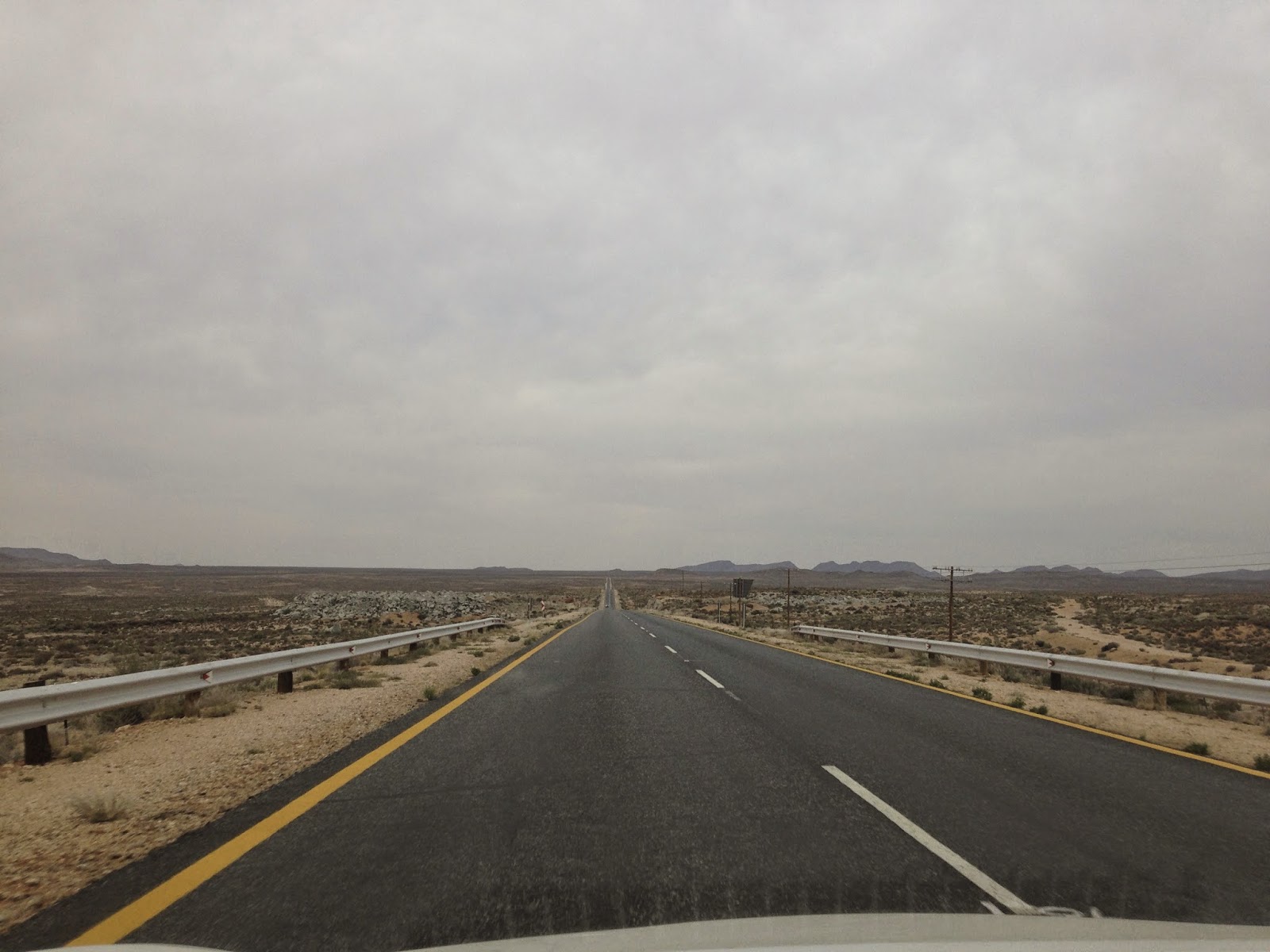
Back in South Africa - on a lovely paved road.