Tuesday, April 2, 2013

Activity 7: Monkey See, Monkey Do and Kitties Too!

Along the Garden Route there seem to be lots of animal sanctuaries.  We went to one elephant park and I think there are other places like it.  There are parks that are home to cheetahs, leopards, lions and other cats.  We went to one park that had many of South Africa’s cat species such as the caracal, the African wild cat (it looked like a house cat) and of course leopards and cheetahs.  It’s hard to see many of these species in the wild (or on a safari) because they are quite elusive so it was neat that we were able to see them.  However, it was not the same - it was like going to the zoo.  We did go into the pen where the cheetahs were and got within feet of the animals which was pretty neat (and rather scary).


We also went to a monkey sanctuary called Monkeyland.  This was a huge fenced in area that holds around 10 species of monkeys including Ring-tailed Lemurs (they have the second largest population outside of Madagascar), Black and White Ruffed Lemurs, Black Howler Monkey, Bolivian Squirrel Monkeys, Spectacled Langur, White-Handed/Gar Gibbon and the Brown Capuchin.  The area that was enclosed was huge so we could walk around without seeing a fence and just looked for monkeys.  We also learned a little bit about the differences between monkeys and apes.  The easy difference is that apes don't have tails.  Then we learned the difference between Old World and New World monkeys.  Old World monkeys came from Africa and Asia while New World monkeys came from Central and South Africa.  Many of the monkeys in the sanctuary were pets that then became to “wild” for their owners.  Others were injured and nursed back to health by Monkeyland.  I'm pretty sure that the monkeys are not rereleased back into the wild, but they may be.  I remember asked the question, but I can't remember the answer and I can't find it on their website.  Anyway, I decided that it would be really cool to be a monkey.

I found that I didn't have very many really clear pictures so here are a handful of the better ones.


The tiny yellow monkey in the middle is a Bolivian Squirrel Monkey (I think - it may also be a Common Squirrel Monkey)


Black Howler Monkey (Fun fact - except for the Blue Whale, Howler Monkeys are known to make the loudest sound on earth)


Black and White Ruffed Lemurs

Ring-Tail Lemurs


White-Handed/Gar Gibbon

Brown Capuchin


Spectacled Langur

Maribou Stork

Chacma Baboon

Cheetahs!!

Monday, April 1, 2013

Activity 6: This will blow your trunks off!

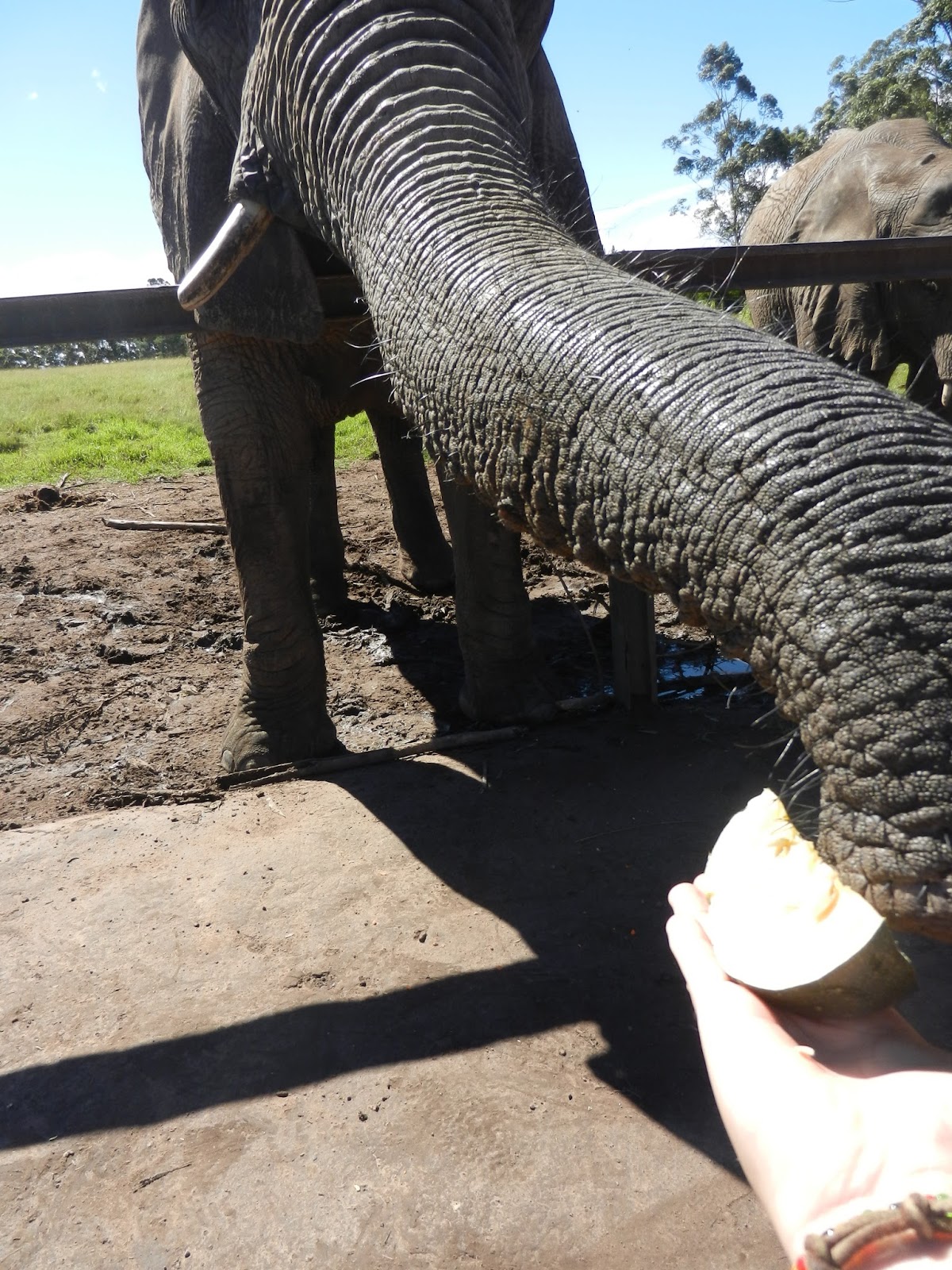
Elephants are huge.  I don’t mean to be Captain Obvious, but it’s true.  Looking back, the elephants that we saw weren’t even that big, but still, they are huge creatures.  We spent the morning of the 4th day of the trip hanging out with elephants.  We drove to a kind of elephant orphanage - also known as the Knysa Elephant Park.  This park is home to about 10 African elephants that were rescued for various reasons.  Occasionally baby elephants are either abandoned or their mother is killed.  The park rescues these orphans and then keeps them in captivity where they end up becoming accustomed to being fed and followed around by tourists.  Although it was kind of strange to see how trained the elephants were and how well they knew the routine their trainers had made for them, it was still pretty cool to see these beautiful (and extremely wrinkly) creatures up close.  Zaas and I fed one elephant whole carrots, squash and various other vegetables.  We held the vegetable in our hand and then held it out for the elephant to pick it up with its trunk.  The trunks were quite strong, but also really gentle and kind of whiskery feeling.  After feeding them, the elephants moved out into a field and in groups followed them around.  We only spent about 30 minutes with the elephants before leaving.  The highlight of this activity was giving an elephant a kiss on the trunk.  It was quite nice and I swear the elephant blushed.


We spent the afternoon walking around a small coastal town walking the streets and then we went to the beach later on.  Zaas and I went for a run and we had a storm in front of us and one coming in from behind.  We got caught in the rain, and watched lightning striking some distance away.  It was a little scary but it was neat to see the storm approaching.


Yup - that's my hand almost up an elephants nose.  There's the phrase that you can't pick your nose or your friends nose, but I hear that it's alright to pick an elephants nose.


They're so wrinkly!!!

Watch your step!  There was so much poop and it was huge.  (Just so you know - I didn't actually step in the poop.)

Elephants have weird feet.

Baby elephants!  


Fun facts about elephants:
Elephants have molars that grow in at intervals throughout their life.  I think they have 6 sets of molars.  Once the last set has grown in and then worn down, the elephant essentially starves.  (Not quite a fun fact - but an interesting one).
Elephants have the longest gestation period - 22 months (sounds pretty miserable).
Elephants live in groups of around 15 and are led by a matriarch (rock on!!).

An elephant joke:
Why did the elephants get kicked off the beach?


Answer:  Because they were walking around with their trunks down.  :)

Sunday, March 31, 2013

Activity 5: Zip-pity Do Dah!

As if bungee jumping wasn’t enough time spent in the air, I spent the rest of the afternoon zip lining through the canopy top.  In my book about wildlife in South Africa the area is known simple as the forest and is characterized as "a community of trees with canopies that touch or interlock, with little or no grass cover.  Ferns, mosses and leaf-litter occur in the understory."  The forest that we were in was indigenous forest, commercial plantations and the ecosystem known as Fynbos.  We were in the Tsitsikamma area along the Garden Route.  The word means "place of abundant or sparkling water" in the language of the Khoi Khoi.  With the Indian Ocean to the south, the Eerste (First) River in the east and the Bloukrans River in the west the names makes perfect sense.

But enough with the fun facts.  This was the first time I had ever done anything like this before.  The last time I was on a zip line I was maybe 10 years old (probably younger) and it was at my elementary school and it was maybe 8 feet off the ground.  I fell off and got the wind knocked out of me.  Luckily, this time I was harnessed in and all the wind stayed in my body.


The zip lining itself was pretty cool.  We all had harnesses that were then clipped into to the zip line.  You had a glove on one hand that you used to brake simply by pulling down on the main line.  There were a couple of shortish runs and then two or three that were quite long where you got going pretty fast.  I wasn’t very good at braking and my landings on the platforms were not graceful, but it was fun anyway.  What was really cool was just being in the forest.  I had never been in an ecosystem like this one.  It kind of reminded me of a jungle, mostly because it was so green and there were so many kinds of trees and other vegetation.  The platforms that we stood on while we waited weren’t bolted into the trees or anything - everything was done with tension.  This ensured that the trees weren’t damaged at all.  The tallest platform was about 15 meters off the ground.  Quite tall, but considering many of us had just jumped off a bridge 216 meters as high, it wasn’t too bad.  We didn’t see any monkeys or anything, but we saw some birds and just the surrounding nature was really nice.

An example of how the platform was attached to the tree.


My and my roommate Jess.


Activity 4: HOPpy Easter

It was strange to spend Easter not doing anything remotely Easter related.  This was the first year that I didn’t dye a singe easter egg.  Instead, I spent the day jumping off a bridge.  In fact, I jumped off a really tall bridge.  Let me clarify these statements - I bungee jumped off the tallest bridge jump in the world at 216 meters off the Bloukrans Bridge.  

Here’s how it worked.  We were all fitted with a harness and then we walked out to the middle of the bridge on a kind of cat walk.  There were platforms built under the road so jumpers didn’t have to worry about what they were about to do, while at the same time trying not to get hit by a car.  Looking back, the walk out was the scariest part because you could see the bottom of the valley and see just how high you were off the ground.  I waited around for a while before it was my turn.  Then, these big pads are attached to your ankles and your strapped in.  Everything was self tightening so when the bungee caught you the harness got tighter and kept you from falling.  Then you HOP up to the edge of the bridge, someone counts to 3 and you push off from the edge and jump.  Then it feels like you’re flying for a while (it was probably only a second or two, but time seemed to move much slower).  It really felt like you were a bird during these brief moments before the bungee catches you.  You end up bouncing upside down for a while and swinging before your momentum ends and you’re just hanging there.  Then it’s just you and your thoughts, a beautiful view of the valley and the river below, a lot of blood rushing to your head and a whole lot of silence.  This was the first absolute silence I had heard all semester and it was quite nice to just be there looking around and listening to nothing.  Apart from all the blood pooling in your skull and a strange pressure behind your eyes it was actually kind of peaceful.  Then a guys comes down, your hooked to another bungee and then hoisted up.  Then, it’s over.  In all, the whole process lasts maybe 5-7 minutes, but it seemed a lot longer and the adrenaline definitely lasted much longer than that.
The bridge.

Rock on!!  I'm so excited 

But...WHAT DID I GET MYSELF INTO??  For a fraction of a second after I heard “3” I think I hesitated, but then I just jumped.  


Weeee!


The way up.


Phew - made it!!  I think it's really funny how red my face is.

Saturday, March 30, 2013

Activity 3: Just Keep Swimming...

The next day where were about 3 different activities that we could choose from.  I chose to go kloofing again.  (Review:  kloofing is essentially jumping from cliffs into water).  I had so much fun doing this before, I figured I would try it again and experience a new river.  We stopped at a place to get wetsuits and life jackets (because the river water was actually quite cold).  Then we drove for a while up a mountain and hiked through someones backyard and through a jungle-esk forest before we reached the river.  We walked along the bank of the river and waded in the shallows for a while.  Climbing over rocks in a wetsuit was more difficult than I thought it would be.  Before we got to the first jump, we had to actually swim along for a while and than climb up some rocks to get to where we could jump.  We all took turns and than swam a ways more to the next jump.  After a few more jumps that were all around 8 meters (much shorter than Suicide Gorge) we had a snack on some rocks and than swam for about 30 minutes before our van met us at the company’s camp along the river.  We returned our wetsuits and life jackets and then headed back to the hostel.  I spent to rest of the day reading and just hanging out.


Sorry - no pictures.  I don’t have an underwater camera.


Friday, March 29, 2013

Activity 2: I hope this doesn’t cave in!!

Our next activity was was to the Cango Caves.  We had the choice between the normal or adventure tour and obviously I chose the adventure.  I thought for sure that we would be scrabling up cave walls and squeezing through tiny cracks, but it wasn't quite that intense.  One of the sections on the, however, was called the tunnel of love and the wall were really close together and you kind of had to squeeze through.  Also at the end of the cave before we turned around, we did have to lay down on our bellies and slide down a short rock slide head first.  The rock formations within the cave were really cool.  You had your classic stalagmites and stalactites, but then were were some other really neat structures.

Sorry the photos aren’t the best quality - but they’ll give you an idea of what the cave looked light.


The largest chamber of the cave was huge.  It has been used in the past as a concert hall.  I think this would have been really cool and the acoustics would have been spectacular.


When I first saw this rock formation, it was instantly reminded of an organ.  It turns out I was right - that was the name of the formation.


Some more cool rocks.  It think it's kind of hard to tell which way was right up in this photos so I very well may have put the photos in upside down.


For the first few nights we stayed in a hostel right on the Indian Ocean.  The first day, despite the rain, I went down to the beach with some friends and we played frisbee.  We also discovered that the water was super warm - much warmer than the Atlantic Ocean which I had been swimming in near Stellenbosch.  So, we went swimming.  We spent the nights just hanging out and talking with some South Africans that came to the hostel bar.  Zaas and I talked with one guy for a while about US and South African politics which was pretty interesting.

Activity 1: Big Bird

As cool as it would be to meet the giant yellow bird who makes its home on Sesame St., the big birds that we met were slightly less sunny in coloration and made their home in an ostrich farm.  When we got to the farm, we were told briefly about the history of the ostrich in South Africa, what the meat and the feathers were used for and some other facts.  Then we got a tour of the farm.  In one pen, there was one bird that we were able to feed.  They are actually quite large and kind of scary up close.  Their beak/lips were leathery feeling and quite strong when you stuck your hand out with some pellets in the palm.  We saw some other pens that seemed too small for the number of birds it contained.  Then we came to a larger pen that had several ostriches it it.  This was where tourists could have the opportunity to ride an ostrich.  Because it was rainy when we were there, we could only sit on the birds.  I didn’t really like this part and I did not sit on one.  The handlers seemed to be very harsh to the birds and they stuck a bag over its head in order for the bird to be calm.  It was all just very strange.  The treatment, the conditions - it just wasn’t sitting well with me.  Our tour ended with lunch and then we moved on to the next activity.

I don’t have any pictures - so instead, here are some fun facts about ostriches.

Ostriches can run up to 40mph.
Fossils of ostriches have been found that date back to 120 million years.  Related to dinosaurs??  I think maybe.
One ostrich eggs equals 24 chicken eggs and takes around 2 hours to hard boil one.
An ostriches eye is bigger than its brain.